


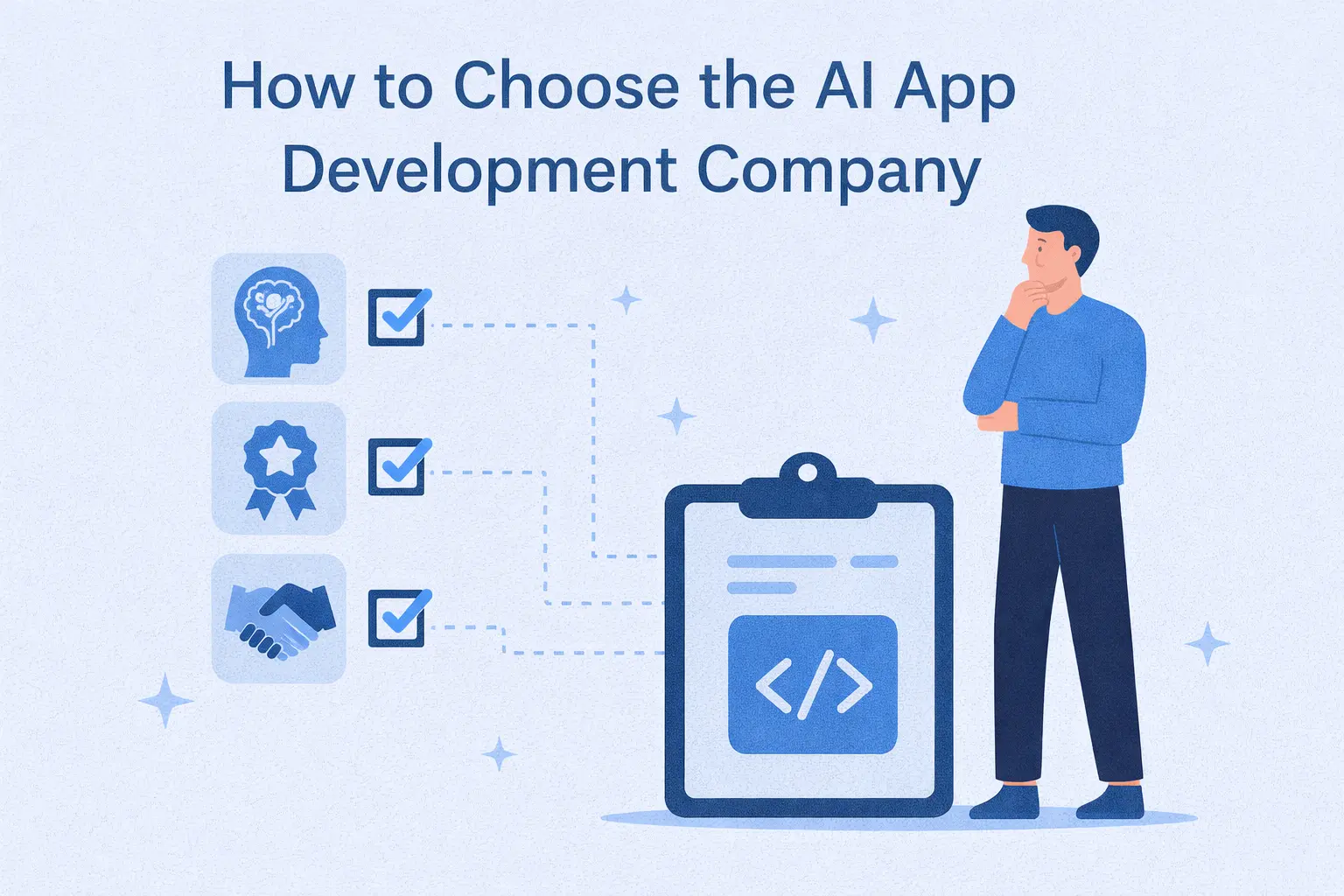
How to Choose the AI App Development Company
Choosing an AI app development company is tougher than selecting a regular mobile app development company. Here, we have to deal with sensitive data, algorithms, how well models actually perform when used daily, unpredictable cloud costs, and scaling plans that all demand careful consideration. One wrong choice can lead to security breaches or cause systems to crash under real-world conditions.
This post provides a practical decision-making guide that examines the technical, operational, and ethical factors that set a good AI app development company apart from those that merely claim to be AI experts.
Define Your Requirements Before You Begin
Clarity is the key when starting an AI project. Without clear specifications or details, it may lead to inaccurate proposals & scope, and partnering with a company that cannot solve your problem.
Start by defining your requirements:
AI Features: Mention whether you need a forecast engine, language processing, image recognition, recommendation systems, or smart workflow. Each one needs unique skills and a tech setup.
Data Specifications: List your data sources (APIs, databases, IoT devices), formats, and volume. Mention the clarity and accuracy checks needed, as well as the rules that apply when tagging items manually.
Compliance Needs: Follow applicable regulations such as HIPAA for healthcare, GDPR for European data, or CCPA for California residents. Compliance impacts how systems are built and where data lives, and also changes logging methods.
Customization Needs: Determine whether ready-to-use models work or if custom development is required. Training existing ones often costs less than starting over from zero.
Data Analytics & Reporting: Figure out what info matters and how often it’s needed, then pick the right layout. While live dashboards require constant updates, scheduled reports run at set times.
Platforms: Choose your main devices (iOS, Android, web, or cross-platform) and whether processing should occur on-device or in the cloud.
Good requirement statements are specific and measurable. Instead of “we need an AI chatbot,” write “we need a customer service chatbot handling 80% of common inquiries with 90% accuracy, integrating with Salesforce CRM, and complying with GDPR.”
Research and Shortlist AI Development Companies
Creating an effective shortlist requires evaluating companies against multiple criteria:
Verified AI Experience: Ask for real case studies where models improved, with clear numbers, and skip vague success stories.
Industry Experience: Healthcare specialists know HIPAA rules, along with how to label medical data. Financial experts catch on quickly to fraud spotting and to handling compliance reports. Real-world know-how means work gets done more quickly without errors piling up.
Technology Specialization: Look into whether the firm focuses on the tech your project needs – TensorFlow, PyTorch, transformer models, or cloud AI services.
Company Reputation: Visit Clutch and GoodFirms for verified reviews. Check LinkedIn to see the technical backgrounds of AI engineers.
When it’s a project from the US, go with teams in matching time zones who speak clearly. Pick no more than three to five firms that fit. Focus on those who reply fast and work when you do.
Evaluate Technical & AI Expertise
Technical Expertise & Tech Stack
Your AI’s speed, size limits, and ease of updates depend heavily on what tech you pick.
Core AI Frameworks: Companies should be experts in TensorFlow for production, PyTorch for research projects, and ONNX for shifting models across different systems.
Advanced AI Tools: Check if they’ve used Hugging Face for smart models or worked with LangChain when building chatbots. Also, see how they handle tools that keep generative AI running smoothly.
MLOps Infrastructure: Systems that log every model’s data, settings, and code help rebuild it later. Automated testing helps in accuracy and performance. CI/CD for AI enables continuous updates built for machine learning.
The tools used shape a model’s precision, speed, growth potential, and maintenance costs over time. Get insights from partners on their deployment workflows, ways they track data and model versions, and also how they handle performance shifts.
AI Expertise & Industry Experience
Genuine AI skills show up through clear proof. Ask for actual results – say, “prediction accuracy jumped from 78% to 91%” instead of fuzzy promises. Diagrams must reveal how data moves, where models run, along with tracking tools
Find out from applicants:
- How do you deal with uneven class sizes in training sets?
- When it comes to spotting changes in model behavior over time, what method do you use?
- Do you know how to decide if a model needs full retraining instead of just tweaking?
Firms that really know their stuff will give clear, solid tech responses.
Review Portfolio, Case Studies & Proven Results
Portfolio evaluation requires examining measurable outcomes rather than completed project lists.
Looking at a portfolio means checking real results rather than just ticking off completed jobs.
Check how well the model works using clear measures like precision, recall, or F1 – see if it handles more data over time by testing real project results – not just isolated cases. Look at how smoothly it integrates with existing tools rather than running on its own. Find out if people actually benefit when AI is added to apps rather than assuming it helps.
Ask for AI trial setups to check out models, flowcharts that track how training info flows across systems, and outcomes recorded after going live.
- What issue did the AI tackle in real use?
- How much improvement was actually seen?
- Any roadblocks pop up – then what happened next?
- Is someone still tweaking it regularly since launch?
Assess Communication, Reliability & Project Management
Communication & Reliability
The way people communicate at the start of a sale significantly influences how smoothly things proceed later. AI development work is tricky from the get-go; results aren’t certain at first, while problems with data pop up as you build.
Evaluate chat apps such as Slack, Jira, or Asana. Be cautious of late deliveries during testing, fuzzy responses to technical details, and weak write-ups in their offers.
Set the expectations for update frequency, primary contacts, escalation, and delivery milestone documentation. Progress check-ins every week, demo sessions twice a month, plus review meetings once a month, this mix usually works well as a starting pace.
Agile Development Process for AI Projects
Agile works well for AI since models improve step by step, while machine learning often brings surprises along the way.
Teams start by trying out basic models, then check how well they work before making improvements bit by bit. Testing keeps going nonstop, covering not just code but also ensuring models act fairly and remain reliable over time. When planning sprints, folks set aside time for training; it’s common for tests to take several days or longer.
Once models go live, they need constant checking of data changes over time, so their accuracy drops without regular updates or refreshes.
Data Security, Compliance & Ethical AI Practices
Data security and compliance in AI systems go beyond standard application security. AI uses sensitive data, can store it, and can make decisions affecting people’s lives.
Regulatory Compliance: GDPR says people must clearly agree before you collect their info; it also means only gathering what’s truly needed while letting users ask how auto-decisions were made. Residents in California can check which personal details companies hold and then tell them to wipe them clean under rules like CCPA. When handling medical records, HIPAA requires strict controls on data, including scrambling, login checks, and logs that track every move someone makes.
Security Standards: Secure systems use end-to-end encryption to keep data safe while moving or being stored. APIs are locked down with strong access checks. Cloud setups follow strict standards such as SOC 2 or ISO 27001. Data labeling follows clear guidelines to protect personal information.
Ethical AI Practices: Avoiding bias in AI starts with varied training data, not just one source, but many different ones. To check if a system is fair, experts run tests that compare results between age, gender, or race groups. Some industries must show how decisions are made, so clear explanations are required by law. Tools like XAI help people see why an AI gave certain answers instead of others. Being open about which data builds these systems helps build trust over time. Before launching any model, it’s key to review its behavior through regular bias checks.
- How do you spot bias and then reduce it?
- Here’s one way: track where flaws pop up, then adjust the data or rules.
- Why does your system predict what it does?
- Break down the reasons step by step.
- Checking live models for fairness: how often is that done?
- Set regular check-ins using real-world results.
- A model causes harm: what next?
- Trigger an alert, pause use, and review impact fast.
Integration Capabilities & Scalability for Future Growth
AI tools need to work alongside current company software while keeping up when operations expand.
Integration Requirements: CRM tools want AI predictions to rank leads. On top of that, ERPs work better with sales forecasts. Meanwhile, data lakes store information in one spot for learning models. Besides this, payment links must catch scams instantly. At the same time, IoT devices send constant updates so machines can stay ahead of failures.
Scalable ML Pipelines: Cloud-based setups on AWS, GCP, or Azure let systems grow as needed; flexible power comes from spreading work across machines. Retraining models using fresh info keeps performance up over time. Instead of stacking more tasks on one machine, extra servers handle the load together; otherwise, boosting a single machine’s strength does the job.
With modular setups, you can update one part on its own, swap out the suggestion engine while leaving the front end alone, or improve data flows without reinstalling the whole software.
Pricing Models, Cost Efficiency & ROI Evaluation
AI development costs go beyond initial development into ongoing operational expenses.
AI-Specific Cost Factors: Model training compute hours vary from hundreds to tens of thousands of dollars, depending on complexity and data volume. Cloud infrastructure costs accumulate for storage, compute for model serving, and bandwidth. Data annotation costs add up quickly. API usage fees apply for third-party AI services. Retraining cycles require budgeting for regular model updates.
Pricing Models: Fixed bid works for clearly scoped projects, but can lead to conflicts when requirements evolve. Time and materials (T&M) provides flexibility, accommodating AI’s experimental nature but requiring oversight. Dedicated team models assign specific engineers monthly, ideal for ongoing development.
Evaluating Value: Consider the total cost of ownership; cheap initial development requiring expensive fixes costs more than quality initial work. Evaluate technical debt from shortcuts, the opportunity cost of delays, and long-term maintainability. Request detailed breakdowns showing development, infrastructure, and maintenance costs separately.
Support, Maintenance & Long-Term Partnership
AI systems require ongoing attention. Machine learning models degrade and evolve over time.
AI Model Lifecycle: Monitoring drifts detects when performance degrades due to shifting data distributions. Handling performance degradation requires processes to identify causes and implement solutions. Regularly updating training data keeps models aligned with current patterns. New regulatory changes may require modifications to the model.
Support Quality: Effective support includes proactive monitoring, identifying issues before users report them, clear escalation paths, defined response time commitments (SLAs), and knowledge transfer, ensuring your team understands the system.
Questions for evaluation:
- What monitoring and alerting do you provide?
- How quickly do you respond to performance degradation?
- What’s your process for urgent updates?
- Do you provide training for our team?
- What’s included in ongoing support versus additional charges?
Conclusion
Choosing the right AI app development company requires a systematic evaluation of technical expertise, communication quality, ethical practices, security compliance, and scalability planning. Prioritize companies demonstrating genuine AI expertise through verifiable case studies with real performance metrics rather than marketing claims.
Ensure strong communication practices are in place before signing contracts. Verify commitment to ethical AI and regulatory compliance. Confirm scalable architecture approaches accommodating growth without expensive rebuilds.
At Flutter Agency, we specialize in building production-grade AI applications combining technical excellence with business pragmatism. Our AI app development team has delivered successful AI projects across healthcare, finance, e-commerce, and logistics, with proven expertise in computer vision, natural language processing, and predictive analytics.
We follow rigorous MLOps practices, ensure comprehensive security and compliance, and build systems designed for long-term scalability. If you’re ready to discuss your AI project with a team that understands both the technology and business implications, visit our AI App Development Company page to learn more and schedule a consultation.


Read and share new topics about all things Tech.
Fill out the form below and we will be in touch soon!
"*" indicates required fields