



MVP Development Companies: How to Choose the Right Partner in 2027
The right MVP development company is the one whose team, process, and price fit your product’s stage, not the one at the top of someone’s ranking. Most US startups pay between $15,000 and $150,000+ for professional MVP development services, and the build usually takes 8 to 16 weeks. Team location, the number of platforms you launch on, and whether you handle regulated data (health records, payments) move the price more than anything else.
Shortlist three MVP development companies, send each the same written brief, and pick the one that cuts your feature list, itemizes the quote, ties payments to milestones you approve, and puts the code and every account in your name from day one.
Search for MVP development companies and you’ll find hundreds of agencies that sound identical, ranked in lists written by the agencies on them. The differences only show up after you sign. This guide won’t hand you another ranking. It shows you how to choose what MVP development services for startups actually include, what US MVP development services cost (planning ranges for 2027, built on current 2026 pricing), how an MVP development agency compares with a freelancer or a nearshore team, and which contract terms to insist on.
Whether you’re leaning toward a US MVP development company or weighing custom MVP development services from a smaller specialist, you’ll leave with a scorecard you can apply today.
What Is an MVP in a Startup?
An MVP, or minimum viable product, is the smallest version of your product that lets real users complete one core job, so you can learn whether the problem is worth solving. When founders ask what is MVP in startup terms, the word that matters is viable; it has to work well enough to produce honest feedback, not just look good in a demo.
An MVP for startup companies is not a cheaper, buggier version of the final product. The goal is learning, not launching, which makes startup MVP development as much a research exercise as an engineering one.
CB Insights’ post-mortems of failed startups repeatedly name “no market need” as a leading cause, cited in roughly 35% to 42% of cases depending on the edition. An MVP is the cheapest way to find that out before your runway disappears, which is why disciplined MVP startups treat the first release as an experiment. MVP development for startups works best when each release tests one assumption at a time.
Three well-known examples show how small a first version can be:
- Dropbox tested demand with a short explainer video before the sync engine was finished. The beta waitlist reportedly grew from about 5,000 to 75,000 people almost overnight.
- Airbnb began as a simple site where the founders rented out air mattresses in their San Francisco apartment during a design conference.
- Zappos founder Nick Swinmurn photographed shoes at local stores, posted them online, and bought each pair only after an order came in.
None of them needed a large engineering team. Each tested one risky assumption.
MVP vs Prototype vs Full Product
- Prototype: tests usability and look, usually with faked functionality and no real users. It takes 1 to 3 weeks and answers “can people figure this out?”
- MVP: a working product for the core workflow, used by a small group of real people. It takes 8 to 16 weeks and answers “does anyone want this?”
- Full product: hardened, scalable, and serving a proven market. It takes 6 to 18+ months and answers “can we serve demand reliably?”
If a vendor quotes your entire wish list as an “MVP,” you’re buying a product, not an MVP.
What MVP Development Services Include: From Ideation to Launch

Good MVP development services cover much more than coding. Minimum viable product development services usually bundle strategy, design, engineering, and QA, while MVP software development services may cover only the build. Know which one you’re buying. A complete engagement turns an idea into a launched, measurable product in these phases:
- Discovery and validation: User interviews, competitor review, and your riskiest assumption defined.
- Scoping and prioritization: Feature list cut to one core workflow, with a written spec and fixed estimate.
- UX/UI design: Wireframes and a clickable prototype tested with real users.
- Development sprints: Frontend, backend, integrations, and admin tools, built in 1 to 2 week sprints.
- QA and security review: Testing on real devices and browsers, plus security and performance checks.
- Launch and deployment: Hosting, app store submission, analytics, and monitoring.
- Measure and iterate: Fix friction, review metrics, and plan version two.
Taken together, the MVP development phases and timeline land at 8 to 16 weeks for most products. Simple single-platform tools can ship faster. Products with complex integrations or compliance requirements take longer.
Whether a vendor calls itself an MVP app development company, an MVP software development company, or an MVP web development company, ask which phases are in the price and which are extra. Strong MVP app development services include all seven phases; weaker ones start at phase four.
Design matters too: MVP development services with UX/UI design providers on the same team reduce handoff errors, and if you need to find MVP designers separately, insist on a clickable prototype that you own.
MVP Development Services in USA: What You’ll Actually Pay in 2027
Pricing is the question every founder asks and few vendors answer plainly. The ranges below combine published 2026 industry comparisons with typical agency pricing, and we expect them to hold broadly into 2027. Treat them as planning numbers, not quotes. MVP development companies rarely publish prices, so use these to sanity-check what you’re quoted.
Cost by Partner Type
| Partner type | Typical hourly rate | Typical MVP budget | Best for | Main risk |
| US-based agency | $100 to $250 | $40,000 to $150,000+ | Funded startups needing same-time-zone strategy | Highest cost |
| Nearshore agency (Latin America, Eastern Europe) | $40 to $100 | $30,000 to $100,000 | Teams that want partial time-zone overlap | Quality varies by team |
| Offshore agency (South Asia, Southeast Asia) | $25 to $60 | $15,000 to $60,000 | Budget-conscious founders with a clear scope | Needs disciplined process |
| Freelancer or small freelance team | $30 to $120 | $5,000 to $30,000 | Simple, single-platform MVPs | Continuity if one person leaves |
| No-code or low-code studio | Often project-based | $3,000 to $25,000 | Testing demand before custom code | Platform limits as you grow |
Headline rates can mislead. Some 2026 comparisons find that once communication overhead and rework are included, an offshore build often costs 60% to 80% of a US agency quote, far more than the hourly-rate gap alone implies. A mid-priced, well-managed team usually beats a cheap one that needs rebuilding.
Price alone is also a poor filter when you evaluate the best MVP development companies for startups. A US MVP software development agency, a nearshore studio, and a freelancer may quote very different numbers for the same brief because they’re pricing different levels of risk.
US MVP development agencies and US MVP development companies charge the most, but they also tend to include more product strategy. Hiring an MVP development company in USA buys time-zone overlap and easier legal recourse if something goes wrong.
Cost by Product Complexity (US Agency Pricing)
- Simple (single-platform app, one core workflow, basic login): about $30,000 to $80,000 and 6 to 10 weeks.
- Mid-complexity (web plus mobile, payments, admin dashboard, 2 to 3 integrations): about $80,000 to $150,000 and 10 to 16 weeks.
- Regulated or AI-heavy (HIPAA-aware telehealth, fintech with KYC, LLM-powered workflows): about $150,000 to $300,000+ and 4 to 8 months.
What Drives the Price
- Platforms: Web only is cheapest. Cross-platform frameworks such as Flutter or React Native cover iOS and Android from one codebase and usually cost less than two native apps.
- Integrations: Each third-party connection (payments, maps, CRM, EHR systems) adds design, build, and testing time.
- Design depth: A clean, standard interface costs far less than custom animation and a bespoke design system.
- Compliance: HIPAA, PCI DSS, and SOC 2 readiness all add architecture and documentation work.
- AI features: Model usage, evaluation, and data-privacy controls add both build cost and ongoing running cost.
- Speed: Compressing the timeline means more engineers working in parallel, which raises the bill.
Costs Founders Forget
Budget beyond the build itself: cloud hosting, an Apple Developer Program membership ($99 per year), a Google Play developer account (a one-time $25 fee), analytics and monitoring tools, legal review of contracts and privacy policies, and post-launch fixes. Many teams reserve roughly 15% to 20% of the build cost per year for maintenance, though your needs will vary.
Which MVP Development Partner Fits Your Stage?
The label “MVP development company” covers very different engagement models, and not all MVP development companies work alike (or even all MVP companies). Match the model to your funding stage and how much product leadership you already have.
- Fixed-scope MVP package: A defined deliverable for a defined price, usually after a paid discovery phase. An MVP product development agency typically offers this after a paid discovery phase, and packaged MVP solutions for startups usually follow the same model. Best when your scope is clear.
- Dedicated MVP development team: A cross-functional group (product, design, engineers, QA) that works only on your product and bills monthly. Best when requirements will evolve.
- MVP as a service: A subscription-style model where you buy sprints of build capacity rather than a fixed project. Useful when you want to test and adjust every few weeks.
- MVP development consultant: An MVP product development consultant, often a fractional CTO, scopes the product, writes the spec, and oversees another team. MVP development consulting is valuable for non-technical founders who can’t judge a proposal alone.
- Bespoke MVP development company: A bespoke MVP development company designs around unusual workflows rather than templates. Bespoke MVP development services cost more than packaged ones but fit products that don’t match a standard pattern.
- Freelancers: Fine for simple products, but plan for continuity if your one developer disappears. If you only need extra capacity, you can hire MVP developers directly instead of engaging an agency, and a minimum viable product development agency may not be necessary at all.
Startup MVP development services at the pre-seed stage should favor speed, a tight scope, and a low burn rate, so a small senior team or a no-code first version often makes sense. MVP development services for pre-seed startups rarely need a full agency team.
MVP development services for early-stage startups with seed funding can justify a fuller team that builds with scale and security in mind. MVP development for tech startups in crowded categories should also budget for fast post-launch iteration.
Two other cases are worth naming. MVP development services for small in-house teams, where your engineers need design or QA help, work best as a short, scoped engagement. MVP development services for enterprise clients, such as a corporate innovation team, add security questionnaires and procurement steps that startups can skip.
How to Choose an MVP Development Company: A 7-Point Scorecard
Shortlist three MVP development companies, send each the same written brief, and score them on the same criteria. When you compare MVP development companies, MVP software development agencies, MVP software development companies, and MVP development agencies side by side, weighting forces you to judge substance over sales polish.
| Criterion | Weight | What a strong answer looks like |
| Relevant product experience | 20 | Shipped MVPs similar to yours, with outcomes after launch |
| Scoping rigor | 20 | Challenges your feature list and recommends cuts |
| Team transparency | 15 | Names the people who will build your product, and they stay on it |
| Commercial terms | 15 | Itemized quote, milestone payments, clear change-order process |
| Security and compliance readiness | 10 | Can explain how they handle your data and any regulations |
| Technology fit | 10 | Mainstream stack with a reason behind each choice |
| Post-launch support | 10 | Defined warranty period and a price for ongoing work |
Score each partner from 1 to 5 per criterion, multiply by the weight, and compare totals. A startup MVP development company with seed-stage clients understands runway pressure; one that mainly serves large enterprises may over-scope your build.
Questions to Ask Every Shortlisted Partner
Send these to every startup MVP development service on your shortlist and compare the answers side by side.
- Which features would you cut from my list, and why?
- Can you show an MVP you built that’s similar to mine, and what happened after launch?
- Who exactly will work on my project, and will they stay until launch?
- How much of your working day overlaps with my time zone?
- How is the quote broken down, and what is excluded?
- Which payments are tied to which milestones, and what do I approve of at each one?
- What happens when scope changes mid-build?
- Will the code repository, hosting, and app store accounts be in my name from the start?
- How do you handle security testing, and who owns data protection if we’re under HIPAA or PCI?
- What does support look like for the first 90 days after launch?
Question one is the most revealing. A partner who tells you what to cut is protecting your runway. A partner who agrees to everything is protecting the invoice.
Red Flags to Walk Away From
These patterns show up again and again when founders compare MVP development companies:
- A fixed price for your full wish list after one call: Real scoping takes more than a conversation.
- No questions about your users or business model: They’re estimating screens, not a product.
- Large upfront payments: Most of the money should follow work you’ve seen and approved.
- Vague answers about who builds it: Senior people on the sales call and juniors on the project is a common pattern.
- Guaranteed app store approval or launch dates: Nobody controls Apple’s or Google’s review process.
- Code or accounts held by the agency: If they own the repository, you don’t fully own your product.
- “Top 10” rankings you can’t verify: Searches for the best MVP development services in the US, the best MVP software development agency in the US, or any top MVP development company return mostly self-published rankings, and many “top MVP development companies” lists are written by agencies that appear on them. Verify reviews on independent platforms and ask for client references you can call.
Choosing the Right Technology Stack
You don’t need to be technical to sanity-check a stack. For web products and SaaS, mature frameworks such as React or Next.js on the frontend with Node.js, Python (Django), or Ruby on Rails on the backend keep hiring easy and costs predictable. For mobile, MVP application development services built on Flutter or React Native let one team ship both iOS and Android, and custom MVP app development services for iOS and Android often start there.
Founders planning MVP app development for startups should ask for one codebase unless native features demand otherwise. Managed services like Supabase, Firebase, and Stripe can replace weeks of custom work.
Ask providers of custom MVP software development services to justify each choice, and be cautious of any obscure stack without a clear reason. The stack you pick today is the one your next hire has to learn.
Industry Requirements: Healthtech, Fintech, SaaS, and AI
US regulations shape both architecture and budget, so raise them in the first conversation, not after launch. US MVP software development services that have handled your regulator before will price risk more accurately.
In short: healthtech needs HIPAA safeguards, fintech needs PCI DSS planning and KYC/AML, B2B SaaS needs multi-tenant design and often SOC 2 readiness, and consumer apps need CCPA/CPRA privacy compliance (plus COPPA if children use them).
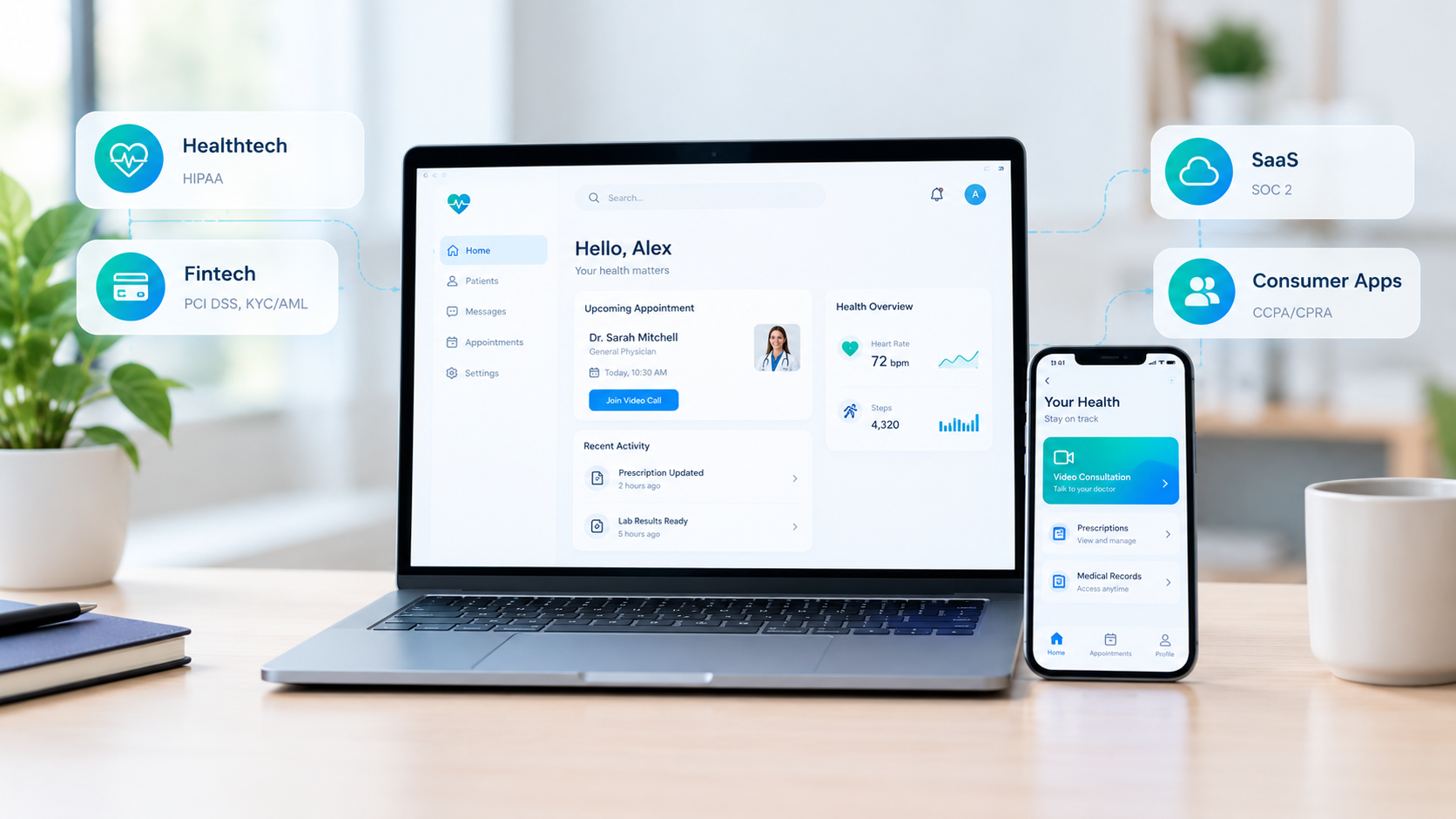
Healthtech. Healthtech startup MVP development carries the heaviest compliance load, so founders searching for the best healthcare MVP development companies for startups should ask about past HIPAA work first. A HIPAA-aware telehealth MVP with video, notes, and push notifications sits at the top of the cost range above, so choose a partner who has handled protected health information before.
Fintech. For a fintech MVP, the best way to choose a custom software development partner is to ask how they limit your PCI scope and who handles KYC checks. Using a payment processor for card data is usually safer and cheaper than storing it yourself.
SaaS. Work with a SaaS MVP development company that designs multi-tenant architecture and role-based access from day one, because retrofitting both later is expensive. SaaS MVP development services should also scope billing and onboarding, and MVP development services for early-stage SaaS startups should treat usage analytics as a core feature, not an add-on. SOC 2 isn’t legally required, but enterprise buyers often ask for it, so ask whether the partner can help you prepare.
Compliance rules change, so confirm requirements with a qualified attorney or compliance advisor before you build.
How AI Is Changing MVP Development Services in 2027
AI shows up in two different ways, and they carry different costs.
AI-assisted building. Many teams now use coding assistants to speed up boilerplate, tests, and prototypes. That can shorten early sprints, but it doesn’t replace discovery, architecture decisions, or security review. Ask any partner exactly where AI is used in their process and who reviews the output.
AI inside your product. If your product depends on language models, you need an AI MVP development partner who plans for evaluation, prompt and model changes, usage-based API costs, and data privacy. Compare AI MVP development services and AI MVP development companies on how they test output quality, not on demo polish. Ask what a thousand active users will cost to serve per month before you commit.
Contracts, IP, and Ownership: What US Founders Should Put in Writing
Many MVP disputes come from missing paperwork, not bad code. Before you pay a deposit, make sure your agreement covers:
- IP assignment: All code, designs, and deliverables assigned to your company on payment, not “licensed” to you.
- Repository and account ownership: GitHub, cloud hosting, domain, and app store accounts created under your company’s name.
- Milestone payments: Tied to demos you approve, with a small final holdback.
- Change-order process: A written way to price scope changes so surprises don’t become arguments.
- Warranty period: A defined window (often 30 to 90 days) for fixing defects at no charge.
- Confidentiality and subcontractors: An NDA, plus disclosure of any subcontractors who will touch your code.
- Exit and handover: Documentation and a transition plan if you part ways.
This is general guidance, not legal advice. Have a startup attorney review the contract.
Local vs Remote: Does Location Matter for US Startups?
Time-zone overlap, investor proximity, and in-person workshops are the real benefits of hiring locally. Plenty of founders still search for an MVP development agency near me because they want a design sprint in the same room.
Rates in coastal hubs typically run higher than in secondary hubs. Teams offering MVP development services in San Francisco and MVP development services in Los Angeles price for deep talent pools and investor proximity, while MVP development services in Austin and MVP development services in Denver often cost less for similar capability.
Across the board, MVP development services in California tend to sit at the top of the national range. Outside the city, MVP development services in New York State may undercut Manhattan rates while keeping the same time zone.
A fully remote US team can also work well if process is strong. Ask for a trial sprint or a paid discovery phase before committing to the full build.
Feature Prioritization: Build Only What Tests Your Riskiest Assumption
Feature creep is the most common reason an MVP overruns its budget. A simple five-step method keeps scope honest:
- Name your riskiest assumption. For example, “Clinics will pay $200 per month to automate intake.”
- List every feature you can imagine. Then sort them with MoSCoW: Must, Should, Could, Won’t (for now).
- Keep only the Musts that touch that assumption. Everything else goes on the version-two list.
- Cut again. If a feature can be handled manually behind the scenes, don’t build it yet.
- Write the success metric before the first line of code.
How to Know Your MVP Worked
Decide what “success” means before you build, or every result will look like a win. Useful early signals include:
- Activation rate: Share of new users who complete the core action in their first session.
- Week-four retention: Whether people come back without prompting.
- Paid conversions or signed pilots: The clearest evidence of willingness to pay.
- Sean Ellis test: If at least 40% of users say they’d be “very disappointed” without your product, you’re approaching product-market fit.
- Qualitative feedback: Ten structured user interviews often explain what the numbers can’t.
Agree on thresholds with your partner in advance, and schedule a review at 30 and 60 days after launch.
When You Don’t Need MVP Development Services Yet
Not every founder needs one of the MVP development companies on your shortlist today, and MVP development for startups doesn’t always require an agency. Hold off if:
- You haven’t talked to potential customers. Ten conversations can reshape your feature list more than any build.
- A no-code tool can test your idea. Landing pages, waitlists, and no-code prototypes can validate demand for a few thousand dollars.
- You already have a technical co-founder. You may need extra capacity, not a full agency.
- The product is very simple. One platform and one workflow may only need an experienced freelancer.
Conclusion: Choose the Partner That Protects Your Runway
Choosing the right MVP development company can determine how effectively you turn your startup idea into a market-ready product. The right partner helps you validate assumptions, control costs, and build something customers actually need.
Before making your decision, keep these points in mind:
- Focus on learning, not features: Build only what you need to validate your core idea.
- Set a realistic budget: Evaluate overall value, timelines, and experience rather than hourly rates alone.
- Evaluate expertise: Use a scorecard, ask the right questions, and look beyond sales presentations.
- Secure ownership: Ensure IP rights, source code, accounts, and exit terms are clearly documented.
- Define success metrics: Agree on activation, retention, and conversions before development begins.
Start by preparing a one-page project brief, comparing three MVP development companies, and running a paid discovery phase with your preferred partner.
Remember, an MVP is the beginning of a feedback loop, not the finish line. The best MVP development services for startups help you validate ideas, protect your budget, and build a foundation for future growth.
Frequently Asked Questions
How do I choose between MVP development companies?
Shortlist three companies with experience building products like yours, send each the same written scope, and score them on scoping rigor, team transparency, commercial terms, security readiness, technology fit, and post-launch support. Prefer the company that challenges your feature list and ties payments to milestones you approve.
How much do MVP development services in USA cost?
Most startups pay between $15,000 and $150,000+ for a first version, using 2026 pricing as the baseline for 2027 planning. Offshore teams and freelancers sit at the low end, US-based agencies at the high end, and regulated products such as HIPAA-compliant apps can exceed $150,000.
How long does MVP development take?
A focused MVP typically takes 8 to 16 weeks from discovery to launch. Simple single-platform products can ship in 6 to 10 weeks, while regulated or AI-heavy products often take 4 to 8 months.
What should an MVP development company deliver?
A strong MVP development company (also called a minimum viable product development company) delivers a validated scope, UX/UI design, a working product covering your core workflow, testing, deployment, analytics, and a defined support period, with all code and accounts in your name.
Should I hire a US MVP development agency or an offshore team?
A US-based company offers time-zone alignment and strong product strategy at a higher price. A well-run offshore or nearshore team can deliver strong results for less if it uses milestone payments and daily communication. Process matters more than location.
Are “top MVP development companies” lists reliable?
Use them only as a starting point. Many are written by agencies that list themselves. Verify reviews on independent platforms, ask for references, and judge partners on relevant work.
What is the difference between an MVP and a prototype?
A prototype tests design and usability, often with faked functionality. An MVP is a working product that real users can use, so you can measure whether they want it and will pay.
Can I build an MVP without hiring an agency?
Yes. If you can code or have a technical co-founder, you can build it yourself. No-code tools also work for simple tests. An agency makes the most sense when you need speed, design, and engineering skills together.





Read and share new topics about all things Tech.
Fill out the form below and we will be in touch soon!
"*" indicates required fields