


Flutter App Costs: Build, Maintain, and Scale in 2026
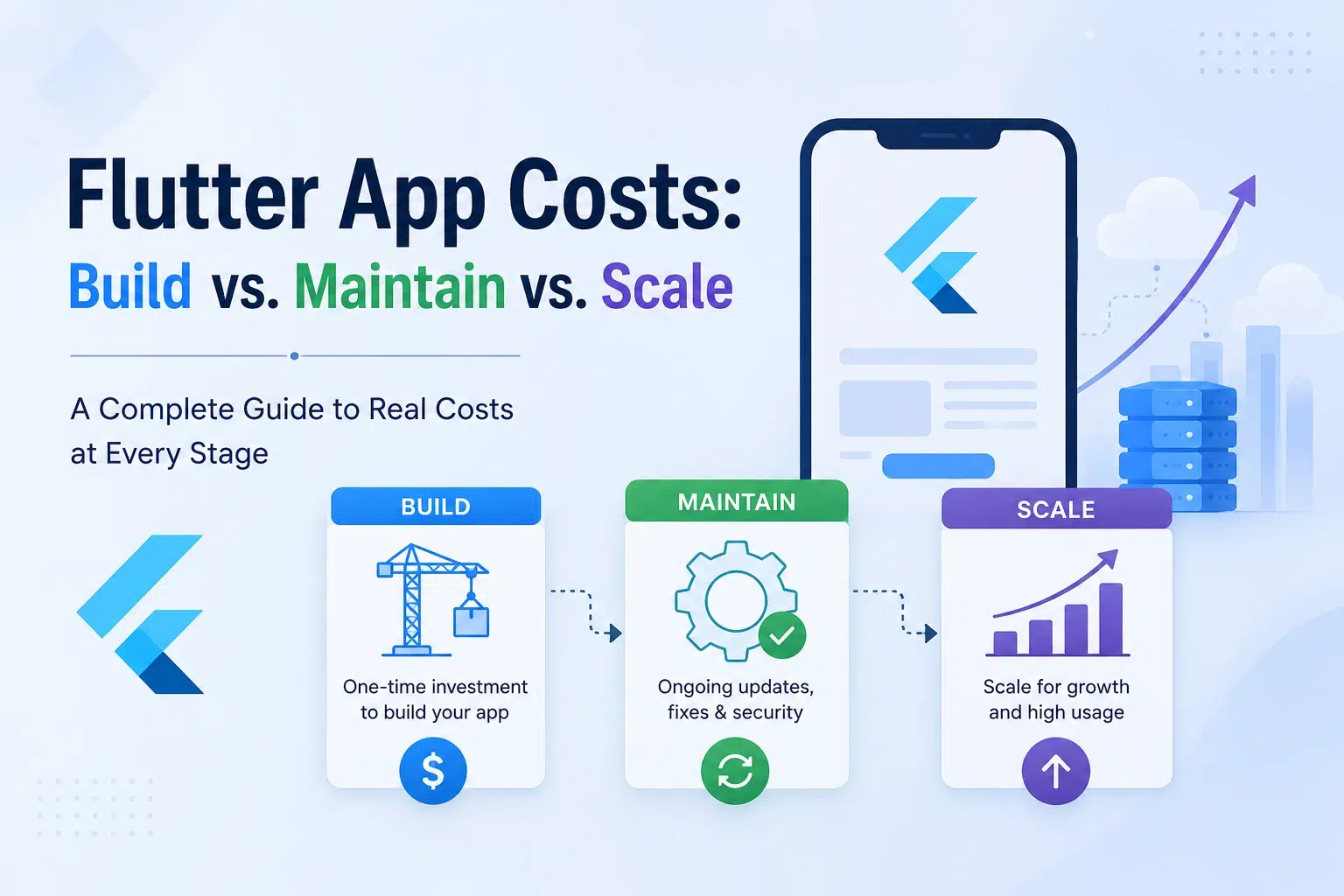
If you’ve asked three different agencies “how much does a Flutter app cost” and gotten three wildly different numbers, you’re not alone. The honest answer is that Flutter app costs aren’t one number at all they’re three separate budget lines: build, maintain, and scale. Each has its own logic, its own triggers, and its own risk of being underestimated.
This guide breaks down all three in detail, with real cost ranges, what drives them up or down, and the mistakes that quietly inflate budgets after launch.
Why “How Much Does a Flutter App Cost” Is the Wrong First Question
Founders ask for a build number because that’s the number they need to raise or approve first. Fair enough. But a build-only quote tells you almost nothing about what the app will cost to own over its useful life.
Industry data on software total cost of ownership consistently shows that build cost is often less than half of what a product costs over 2-3 years. Flutter is no exception. The framework changes how costs are distributed not whether maintenance and scaling exist.
Here’s the quick version, before we go deep on each phase:
- Build: $8,000–$150,000+, one-time, feature-dependent
- Maintain: 15-20% of build cost, every year, ongoing
- Scale: Usage-triggered, ranges from a few thousand to $50,000+ per event
Now let’s unpack each one.
Phase 1: Build Cost
Build cost is what most people mean by “Flutter app cost.” It covers design, development, testing, and initial deployment to app stores.
Cost by Complexity Tier
| App Type | Typical Build Cost |
|---|---|
| Simple app (MVP, few screens) | $8,000 – $25,000 |
| Mid-complexity app (custom UI, APIs) | $25,000 – $70,000 |
| Enterprise app (custom backend) | $70,000 – $150,000+ |
A simple app usually means under 10 screens, a single user role, and minimal backend logic think a content or booking app with no payment processing.
Mid-complexity apps add custom API integrations, user authentication, and more intricate UI. This is where most funded startups land many start with an MVP development approach to validate the idea before committing to the full build.
Enterprise apps involve custom backend architecture, multiple user roles, complex permissions, and often integrations with existing internal systems. This level of work typically calls for a full custom mobile app development engagement rather than a template-based build.
What Actually Moves the Number
Two apps in the “mid-complexity” tier can differ by $30,000 depending on a few specific choices:
- Design complexity – custom illustrations and animations cost more than using a component library
- Backend architecture – Firebase is cheaper and faster than a custom Node.js/Postgres backend, but less flexible
- Real-time features – chat, live location, or push-based updates add meaningful engineering time
- Payment/subscription logic – billing edge cases (refunds, proration, trials) are more work than they appear
- Team composition – an agency with senior engineers costs more per hour but often finishes faster, which can net out similar or lower overall; you can also hire Flutter developers directly if you already have a defined scope
- AI-driven features – recommendation engines, chatbots, or smart automation are increasingly common through dedicated AI app development work
The single biggest cost inflator isn’t any of these individually – it’s scope changing mid-build. Locking requirements before development starts is the most effective (and most ignored) cost control available.
Phase 2: Maintenance Cost
This is the phase most first-time app owners underestimate, and it’s where a lot of “we didn’t budget for this” moments happen.
What Maintenance Actually Covers
| Maintenance Item | Typical Cost Driver |
|---|---|
| OS/SDK version updates | Apple & Google force annual compatibility updates |
| Bug fixes & crash monitoring | Real-world usage surfaces issues QA doesn’t catch |
| Third-party API/library updates | Vendors update on their own release schedule |
| Security patches | Ongoing, compliance and trust-driven |
As a baseline, budget 15-20% of your original build cost, every year. A $50,000 app needs roughly $7,500–$10,000 annually just to remain stable – before adding a single new feature.
The Maintenance Costs Nobody Mentions
Most pricing guides list the four items above and stop. In practice, a few less obvious cost drivers show up consistently:
- Flutter SDK major version upgrades can break third-party packages that haven’t been updated, requiring rework that has nothing to do with your app’s actual features
- App store policy changes – Apple and Google periodically require new permission flows or privacy disclosures, forcing UI changes on a deadline
- Vendor pricing changes – map, payment, or AI API providers change their pricing tiers, and that cost flows directly into your operating budget
- Store rejection cycles – a rejected submission means developer hours spent diagnosing and resubmitting, on top of the delay
None of these are Flutter-specific failures. They’re the ordinary cost of running software in an ecosystem that keeps moving. The mistake is not budgeting for them, not that they exist.
Phase 3: Scaling Cost
Scaling cost is the least predictable of the three, because it isn’t tied to a calendar – it’s tied to growth. A 500-user app and a 500,000-user app are, cost-wise, almost different products.
What Triggers Scaling Spend
| Scaling Trigger | Typical Cost Impact |
|---|---|
| Backend can’t handle load | Re-architecture, $15,000–$50,000+ |
| New markets/languages | Localization, $5,000–$20,000 |
| New platform (web/desktop) | Lower – Flutter reuses ~70-80% of code |
| Team growth needed | Ongoing salaries, not one-time |
The backend, not the Flutter app itself, is usually the first thing to strain under growth. An app built on Firebase for an MVP may need to migrate to a custom backend once traffic and data complexity increase – that migration is a real, sometimes underestimated cost.
The One Advantage Worth Highlighting
Here’s where Flutter earns back some of the cost it doesn’t save at the build stage: because the UI layer is a single shared codebase, expanding to web or desktop later reuses the majority of existing code – a web app development extension is usually far cheaper from an existing Flutter codebase than starting a browser-based product from zero. Teams that built native iOS and Android apps separately don’t get this – they’d be starting a third build from scratch.
Flutter vs. React Native: A Cost-Focused Comparison
Since Flutter is almost never evaluated in isolation, it’s worth a direct comparison on cost specifically – not features.
| Factor | Flutter |
|---|---|
| Initial build cost | Comparable to React Native |
| UI consistency across platforms | Higher – Flutter renders its own UI |
| Long-term maintenance cost | Generally lower – fewer native-bridge bugs |
| Developer availability/hiring cost | Growing pool, competitive rates |
The practical takeaway: don’t choose based on build cost alone, since it’s roughly a wash. Choose based on which framework’s maintenance profile fits your team’s long-term plans.
A Budgeting Framework You Can Actually Use
Instead of asking “what will this cost,” ask three separate questions and budget each one:
| Phase | Budgeting Question |
|---|---|
| Build | What features are in scope for launch? |
| Maintain | What’s 15-20% of that build cost, annually? |
| Scale | What usage level would strain the current backend? |
Answering all three before development starts not after launch is what separates teams that run out of runway from teams that don’t.
Common Mistakes That Inflate Flutter App Costs
A few patterns show up repeatedly across underbudgeted projects:
- Treating the build quote as the total budget, with no maintenance line at all
- Choosing the cheapest build quote without checking what’s excluded (often maintenance, testing, or store submission)
- Letting scope expand mid-build without renegotiating cost or timeline
- Delaying backend architecture decisions until scaling problems force an emergency fix
- Assuming “cross-platform” means zero platform-specific work Flutter still needs testing and tuning on both iOS and Android
Every one of these is avoidable with upfront planning, not extra spend.
Flutter App Costs: FAQs
How much does a Flutter app cost to build?
Simple apps typically cost $8,000–$25,000, mid-complexity apps range from $25,000–$70,000, and enterprise apps can cost $70,000–$150,000+, depending on backend complexity and integrations.
How much should I budget annually for Flutter app maintenance?
Plan for around 15–20% of the original development cost annually. This typically covers OS updates, bug fixes, third-party library updates, and security patches.
What actually triggers scaling costs for a Flutter app?
Scaling costs usually increase when user growth exceeds your backend capacity, you expand into new markets or languages, or you add platforms such as web or desktop.
Is Flutter cheaper than React Native long-term?
Initial build costs are generally comparable. However, Flutter can be more cost-effective over 2–3 years because maintaining a single codebase may reduce platform-specific bugs and maintenance effort.
What’s the biggest avoidable cost mistake in Flutter app development?
The biggest mistake is treating the initial build quote as the entire budget. Plan separately for ongoing maintenance, infrastructure, third-party services, and future scaling from the beginning.
The most useful thing you can do before signing any Flutter development quote is ask for build, maintenance, and scaling as three separate numbers. A vendor unwilling or unable to break it down that way is a sign the quote hasn’t been thought through past launch day.
If you’d rather skip the guesswork, get in touch with the Flutter Agency team for a scoped, phase-by-phase cost estimate based on your actual feature list.





Read and share new topics about all things Tech.
Fill out the form below and we will be in touch soon!
"*" indicates required fields