


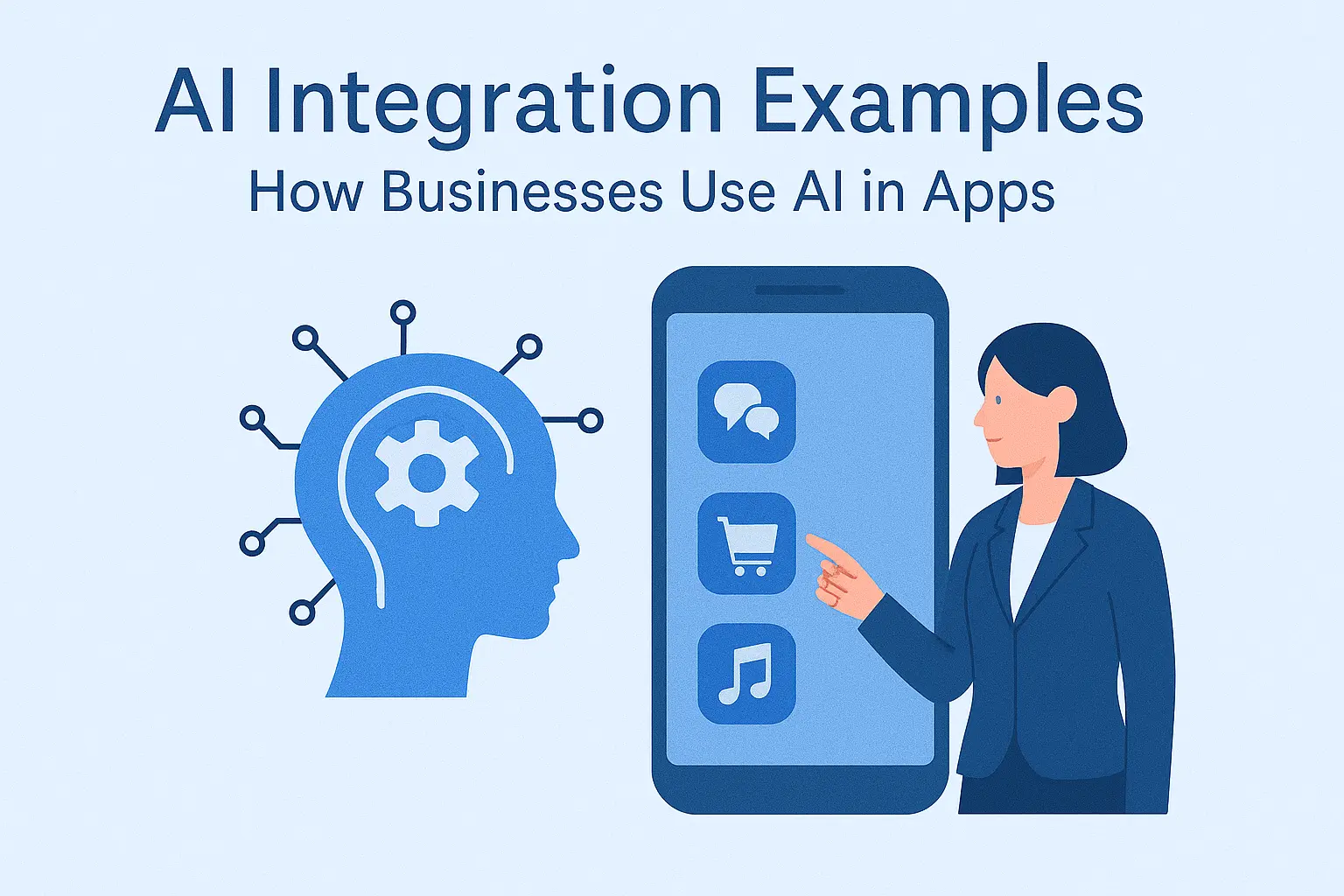
AI Integration Examples: How Businesses Use AI in Apps
From personalized product suggestions to always‑on virtual assistants, AI has quietly become the engine behind modern apps, powering the experiences users now expect as standard. Recent market research suggests that the global AI apps market could surpass USD 5 billion by 2025, underscoring the rapid investment by businesses in intelligent features across their digital products.
Instead of static interfaces, leading apps now learn from every tap, swipe, and search to deliver experiences that feel uniquely tailored to each user. This article takes a practical look at how companies integrate AI into their apps, from recommendation engines and chatbots to predictive analytics and computer vision, so you can see what real integration looks like, not just why it matters.
Let’s explore real‑world AI integration examples that show how artificial intelligence is redefining app development today.
What Does AI Integration Mean in App Development?
Integrating AI into apps involves adding smart tools, such as learning algorithms, speech understanding, or trend forecasting, to help applications act sharply and adjust on their own. Because of this, programs can study how people use them, spot habits, and improve responses over time.
Chatbots in apps often utilize NLP to act like real talkers. Instead of typing, you can speak thanks to voice tools that support no-hand control. Recommendation systems tailor what you see by learning your likes. These smart picks are based on patterns observed in human behavior. Predicting future actions or shifts? That’s where forecasting features step in. For spotting faces or items in photos, image detection is built right into many programs.
The benefits of integrating AI in apps are substantial. Personalization improves user engagement by tailoring experiences uniquely to each individual. Doing basic tasks automatically helps things run smoothly while cutting down on hands-on work. With smart tech spotting trends, companies act quicker on info, making them more flexible when growing or reacting. In general, adding AI turns fixed programs into live tools that learn over time instead of just sitting there.
This method turns AI setup into a key move for companies wanting to build fresh, standout mobile apps past 2025. Tech like this boosts app features while helping digital tools stay strong amid fast market shifts.
Real-World AI Integration Examples in App Development
AI integration in app development is transforming how businesses engage users by embedding smart technologies that make apps adaptive and personalized.
AI-Powered Personalization in Retail Apps
Take Amazon and Shopify, for instance: they use AI-powered recommendation engines that analyze user behavior like browsing history and past purchases to suggest products tailor-made for each shopper. Amazon’s system dynamically adapts these recommendations in real time by analyzing shopper sessions and preferences, while Shopify merchants use AI apps to provide personalized product discovery directly on their storefronts. This personalization enhances user engagement and significantly boosts conversion rates, turning browsers into buyers and increasing sales revenue for retailers.
Chatbots and Virtual Assistants in Service Apps
In the realm of service apps, chatbots and virtual assistants like Duolingo’s AI tutor and Bank of America’s Erica demonstrate natural language processing (NLP) capabilities. These AI-driven tools simulate realistic conversations, helping users learn languages or manage finances anytime. Duolingo’s AI tutor personalizes lessons based on user progress, while Erica offers 24/7 banking support by handling transactions and answering queries. These AI assistants reduce wait times and operational costs while improving customer satisfaction and engagement.
Predictive Analytics in Healthcare and Fitness Apps
Healthcare or fitness apps use smart number-crunching to guess health patterns pretty accurately. Take MyFitnessPal or Fitbit; they check your moves, food intake, and body stats to give advice that fits you better. These clever tools keep people on track by showing progress and boosting well-being, and they also keep them hooked with custom tips; at the same time, doctors get live updates so they can step in early when needed.
Computer Vision in On-Demand and E-Commerce Apps
Computer vision powers interactive features in on-demand and e-commerce apps as well. Pinterest Lens enables users to take photos and instantly search for similar items, while Sephora’s augmented reality (AR) try-on lets customers virtually apply makeup products before purchasing. Smart visuals help shoppers find items more easily, boost engagement, and make users feel more confident about making a purchase, which lifts sales over time.
Beyond these cases, firms such as Mercedes-Benz incorporate smart assistants powered by AI in car apps, letting drivers stay focused without touching screens. Meanwhile, UPS applies artificial intelligence to fine-tune delivery paths, cutting fuel use while boosting speed and reliability. These uses lead to smoother business operations and customer satisfaction, no matter the field.
These varied real-world examples demonstrate how AI integration not only improves user engagement but also delivers tangible business benefits such as increased revenue, reduced costs, and scalability, proving essential for competitive app development in 2025.
How Businesses Integrate AI into Apps (Step-by-Step Overview)
Identifying Use Cases
Businesses add AI to apps by starting smart spotting where it actually helps. First off, they pin down issues an app could fix, like using chatbots instead of live agents or fine-tuning what gets suggested to users. Picking these tasks keeps things goal-driven, so results matter, not just flashy tech. That way, the tool does real work, not window dressing.
Choosing the Right AI Framework or API
After that, companies pick an AI tool or API fitting their needs, plus tech setup. Some go for TensorFlow to create custom ML models, while others use the OpenAI API when handling language tasks. Google’s ML Kit works well for mobile-based features instead. AWS AI Services are common for cloud-powered solutions that can grow. Picking the best option means weighing things like precision, price, room to expand, and how smoothly it fits into current systems.
Data Preparation and Training
The third step handles data prep plus model training. Here, unprocessed info gets gathered and tidied up while being adjusted into a format the AI can use. Good-quality input matters because the system picks up patterns from it in order to do its job well. During this stage, datasets are divided into chunks for training, checking progress, and the final evaluation; features also get fine-tuned and scaled down, so performance improves.
Testing and Scaling
Once models are trained, businesses integrate AI into the app’s backend or frontend systems using APIs or custom code. Rigorous testing follows to ensure AI features perform as expected, covering unit, integration, and user acceptance tests. Testing verifies accuracy, response times, and handling of edge cases, preventing issues after deployment.
Finally, scaling the AI-enabled app smartly is vital. Starting with focused features, companies gather real user feedback and iteratively improve the AI components. This phased approach enables gradual expansion of AI capabilities while maintaining stable app performance.
Successful AI integration blends strategic use case planning, thorough data readiness, and expert development skills. Partnering with experienced AI developers or specialized agencies is often crucial to navigate technical challenges and deliver scalable, high-impact AI features that meet business goals in 2025 and beyond.
Why Partner with an Expert Agency for AI App Integration?
Partnering with an expert AI app development company for AI app integration brings crucial advantages, especially when dealing with the complex challenges of data privacy, scalability, and maintaining app performance. AI integration requires handling vast amounts of sensitive data securely, ensuring compliance with regulations without compromising user experience. Expert agencies have the knowledge and practices necessary to embed strong data privacy protections directly into the AI workflows.
Scalability is another critical factor. AI features can demand heavy computing resources, fluctuating with user loads. A professional agency understands how to architect solutions that scale elastically across cloud environments, keeping apps responsive and reliable during both normal operation and peak usage.
Maintaining overall app performance alongside AI functionalities is a delicate balance. Poorly optimized AI models or inefficient integration can slow apps down or cause crashes. Experienced developers optimize AI workloads and integrate seamlessly with the app’s architecture to ensure an enhanced user experience without added complexity or lag, truly AI built right into your app experience.
Flutter Agency is a go-to choice for teams wanting smart mobile apps built right. Instead of just adding tech, they shape AI tools that match your actual business needs. Using Flutter, their crew builds smooth cross-platform apps powered by modern AI systems. Rather than making things harder, they keep it simple, boosting speed, smarts, and personal touches in every feature.
Teaming up with experts like Flutter Agency gives companies the latest AI tools along with expert advice to make sure adding AI fits both tech needs and real-world goals. Working together this way lowers risks while speeding up launch times and brings solid results that keep your app ready for what’s next in a fast-changing online world.
In short, teaming up with a skilled agency helps tackle AI hurdles like data safety, size limits, or speed instead of unlocking its real power for your apps. Flutter Agency shows how it’s done: mixing solid AI know-how with Flutter’s quick workflow to create smart, flexible apps that users love while boosting business results.
Future of AI Integration in App Development
The future of AI integration in app development promises transformative advancements that will make apps smarter, more adaptive, and highly personalized. Here are key trends shaping this future:
AI Agents
Autonomous AI agents will handle complex tasks within apps, from personalized shopping assistants to intelligent scheduling. These agents work proactively, anticipating user needs and automating decision-making processes, greatly enhancing convenience and efficiency.
Edge AI
Processing AI models directly on devices rather than in the cloud will become widespread. Edge AI improves response times and preserves user privacy by minimizing data transmission. This trend is crucial for applications demanding low latency, such as healthcare monitoring or real-time language translation.
Personalized User Experience (UX)
AI will deliver hyper-personalized interfaces that dynamically adapt to each user’s behavior, preferences, and context. Apps will use AI to customize content, notifications, and workflows on the fly, creating highly engaging and intuitive experiences unique to every user.
Multimodal Models
Combining data from text, voice, images, and video, multimodal AI models will enable apps to understand and interact in more natural and versatile ways. This integration will underpin innovations like immersive AR experiences and smarter virtual assistants.
Businesses that adopt these AI technologies early will gain a competitive advantage through improved user retention, operational efficiency, and increased innovation capacity. As one expert notes, “The future of app development isn’t just digital; it’s intelligent.”
In summary, the next years will see AI deeply embedded across app workflows, making software truly smart and responsive, empowering businesses to deliver value at scale while delighting users with personalized and seamless experiences.
For more insights on how AI is transforming mobile app ecosystems, you can also read AI in App Development: The Future of Smarter Mobile Apps.
Conclusion
AI is shaking up how companies work, changing everything from daily tasks to customer chats. Instead of old methods, businesses now use smart tools built into apps that learn what users like. This means less manual effort plus quicker responses behind the scenes. Smarter decisions come from real-time data, not guesses or delays. Happier customers stick around longer while profits grow without extra strain. Over time, these small wins add up to a solid edge over rivals doing things the usual way.
When AI keeps changing fast, picking a solid team for building smart apps really matters. Good agencies know how to handle tough stuff, think data safety, room to grow, and smooth tech links so your app works better, not harder. Teaming up with outfits like Flutter Agency means you get sharp AI tools mixed with strong mobile skills, shaping apps that learn, adjust, and match what your business needs.
If you’re thinking about adding AI to your app, start by figuring out what your business actually needs. Work with people who know AI well; trust matters. Build a clear plan that balances real user benefits with solid tech choices. Apps are getting smarter, no doubt. Teaming up with skilled folks helps you make the most of it, boosting growth without the guesswork.
Empower Your App with AI – Build with Flutter Agency
Bring intelligence, automation, and personalization to your apps with AI integration and custom mobile app development by Flutter Agency.
Our team of experts blends AI innovation with Flutter excellence to help your business build smarter, faster, and more scalable digital products.
Whether you need AI app development or a custom-built Flutter solution, we’ll make it happen. Talk to Flutter Agency Today





Read and share new topics about all things Tech.
Fill out the form below and we will be in touch soon!
"*" indicates required fields